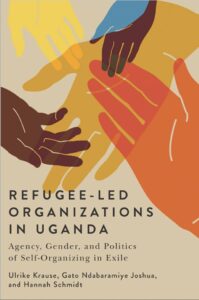
 We are delighted to announce the publication of our new book, Refugee-Led Organizations in Uganda: Agency, Gender, and Politics of Self-Organizing in Exile – a project long in the makingand in stock in mid-April.
The book was co-authored by Ulrike Krause, Gato Ndabaramiye Joshua, and Hannah Schmidt, and draws on the research project Global Refugee Protection and Local Refugee Engagement: Scope and Limits of the Agency of Refugee-led Community-based NGOs, funded by the Gerda Henkel Foundation. It explores the vital yet often overlooked role of self-organization in the lives of refugees. Through empirical research in Uganda’s Kyaka II camp and Kampala, the work reveals how people challenge political restrictions, create economic opportunities, and foster social belonging – collectively by self-organizing. Spanning the spectrum from informal collectives to formalized organizations, it centers how people establish their own support systems in times of emergency and everyday life – and also what challenges they encounter. By placing particular focus on gender, it examines how power dynamics, social roles, and intersecting inequalities shape both the practices of self-organization and the possibilities for accessing self-organized support structures.
Published open access, the book is freely available to readers worldwide, ensuring that these insights reach the communities and also practitioners to whom they matter to.
A very special thank you goes to all our interlocutors who shared their experiences and insights, without whom this project would not have been possible. We are also deeply grateful to everyone who supported this work along the way.
Reference: Krause, Ulrike, Gato Ndabaramiye, Joshua, and Schmidt, Hannah (2026), Refugee-Led Organizations in Uganda. Agency, Gender, and Politics of Self-Organizing in Exile, eds. Megan Bradley and James Milner (Mcgill-Queen’s Refugee and Forced Migration Studies Series; Montreal, Kingston, London, Chicago: McGill-Queen’s University Press).
Description: Self-organization plays an essential yet often overlooked role in the everyday lives of refugees in exile. By self-organizing, they challenge restrictions, claim political representation, foster social relations and belonging, and create ongoing economic opportunities.
While government authorities and aid organizations are supposed to provide protection and assistance, refugees often continue to face adversities, restrictions, and risks, prompting them to establish and maintain their own support systems. Refugee-Led Organizations in Uganda offers nuanced insight into the problems arising from the aid system and especially the significance of the spectrum of informal and formalized self-organizations. Ulrike Krause, Gato Ndabaramiye Joshua, and Hannah Schmidt draw on a gender-sensitive understanding of relational agency and situated knowledge and use empirical research in Uganda’s camp Kyaka II and the capital, Kampala, to reveal how individuals collectively contribute to their own support in times of emergency and in everyday life.
Interwoven with reflections written by refugees in Uganda – Bengekya Mugay Gédéon, Noella Kabale, Paul, Janvier Hafasha, and Isreal Katembo, as well as the director of an LGBTQ+ refugee-led organization – the book centres on individuals’ lived experiences of self-organization in exile.